

Your AML/CTF obligation. Our tools to help you carry it.
Australia's Tranche 2 AML/CTF reforms extend obligations to accounting practices and other DNFBPs when they provide covered designated services with an Australian geographic link. If they reach your practice, your firm is the reporting entity and the obligations are your firm's own -- Fedix cannot take them on, and does not claim to. What Fedix is: an included tool that drafts the paperwork, runs the checks it can actually run, and keeps the records, so the work you have to do is less of it. You review, you decide, you lodge.
Last reviewed 25 August 2026 against current AUSTRAC guidance. General information only, not legal advice. Confirm how the Act and transition rules apply to your services and customers with AUSTRAC or your adviser.
Manual KYC is slow, expensive, and risky
Client due diligence done by hand does not scale past a certain client count.
Hours per client
Manual form-filling, chasing documents, and cross-referencing lists eat up hours for every single client onboarding.
Sanctions & PEP lists
DFAT sanctions lists and PEP databases change constantly. Manual checks are error-prone and hard to evidence.
7-year retention burden
AUSTRAC requires you to retain KYC records for 7 years. Whatever you use must be retrievable, complete, and auditable for that whole period.
What the tool does — and what stays with you
Six things Fedix can take off your desk. None of them is a compliance decision, and none of them discharges an obligation. Read each one for what it is, and for what it is not.
AI-drafted risk assessment
Fedix drafts a risk rating from client type, industry, geography, and transaction patterns, with a plain-English explanation. It is a draft for your file, not a determination. The ML/TF risk assessment is your firm's obligation under the Act and the rating is your decision.
DFAT sanctions screening
Screening against the current DFAT Consolidated Sanctions List, with re-screening when the list is updated. Scope: the DFAT Consolidated List only. If your risk assessment requires UN, OFAC, EU or any other list, you must screen those separately -- Fedix does not.
Political-exposure indicators (AI-assisted)
AI-assisted political-exposure indicators to prompt your review. This is NOT a licensed PEP database and is not a substitute for one. Treat it as a starting point: if your risk assessment requires PEP screening, use a licensed source and record your own conclusion.
Document checklists and tracking
Document checklists per client type (individual, company, trust, SMSF), with collection status and expiry tracking. Which documents your Part B procedures require, and whether what you collected is sufficient, remains your call.
Practice-wide visibility
One view of where each client sits: outstanding assessments, upcoming renewals, and risk distribution. It shows you your own position -- it does not monitor your compliance for you.
Records kept for your 7-year retention
Every assessment, screening result and decision is stored and exportable, built to the AML/CTF Act's retention requirements. The record-keeping duty is your firm's -- Fedix holds the records so you can discharge it.
How the tool fits your workflow
Connect your clients
Sync your client list from Xero, import from CSV, or add manually. Existing client data is automatically mapped.
Fedix drafts the paperwork
A draft risk rating, DFAT sanctions screening, AI-assisted political-exposure and adverse-media indicators, and the document checklist -- prepared for you to work from. Nothing here is a compliance determination.
You review and you decide
The draft is not the decision. You review every finding, add your notes, request further documents, and record the compliance decision. Under the AML/CTF Act that decision is your firm's, and it is your firm AUSTRAC holds to it.
You keep monitoring -- Fedix keeps the file
Alerts when the sanctions list changes, when an assessment ages, or when a new indicator surfaces. You review every alert and act on it. Fedix keeps the evidence so you can show your working. Ongoing customer due diligence is your firm's obligation, not ours.
Watch the workflow in the product
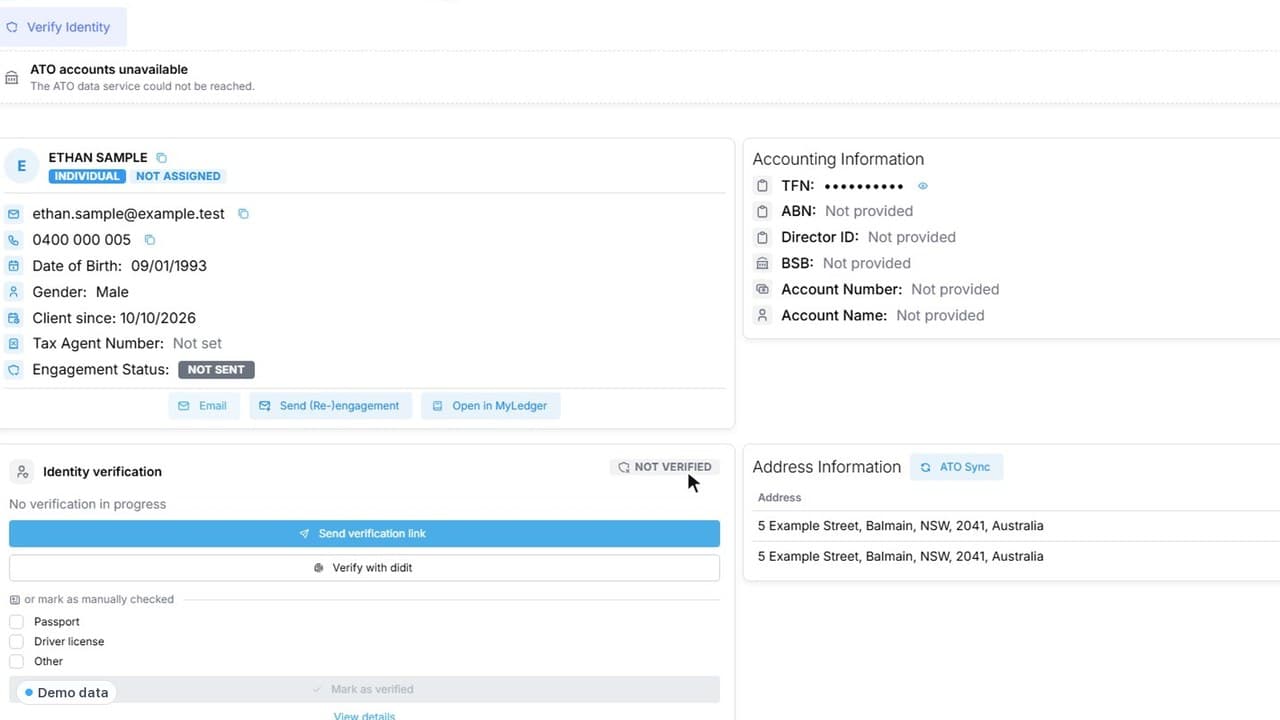 1:16Identity verificationRequest an identity check for a client and follow its status. Your practice reviews the result and records its own decision.
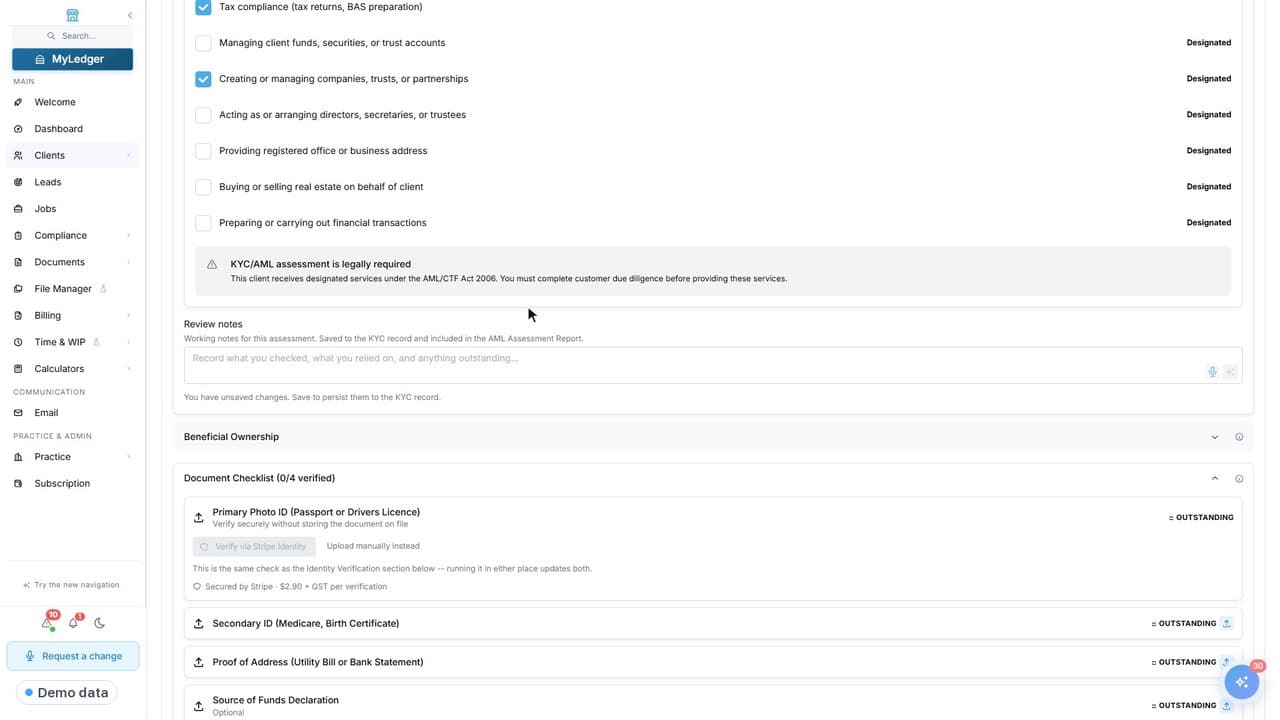 1:37KYC and AML assessment walkthroughWalk through a KYC and AML assessment for a client. The tool keeps the evidence and steps together; the assessment and sign-off stay with your practice.
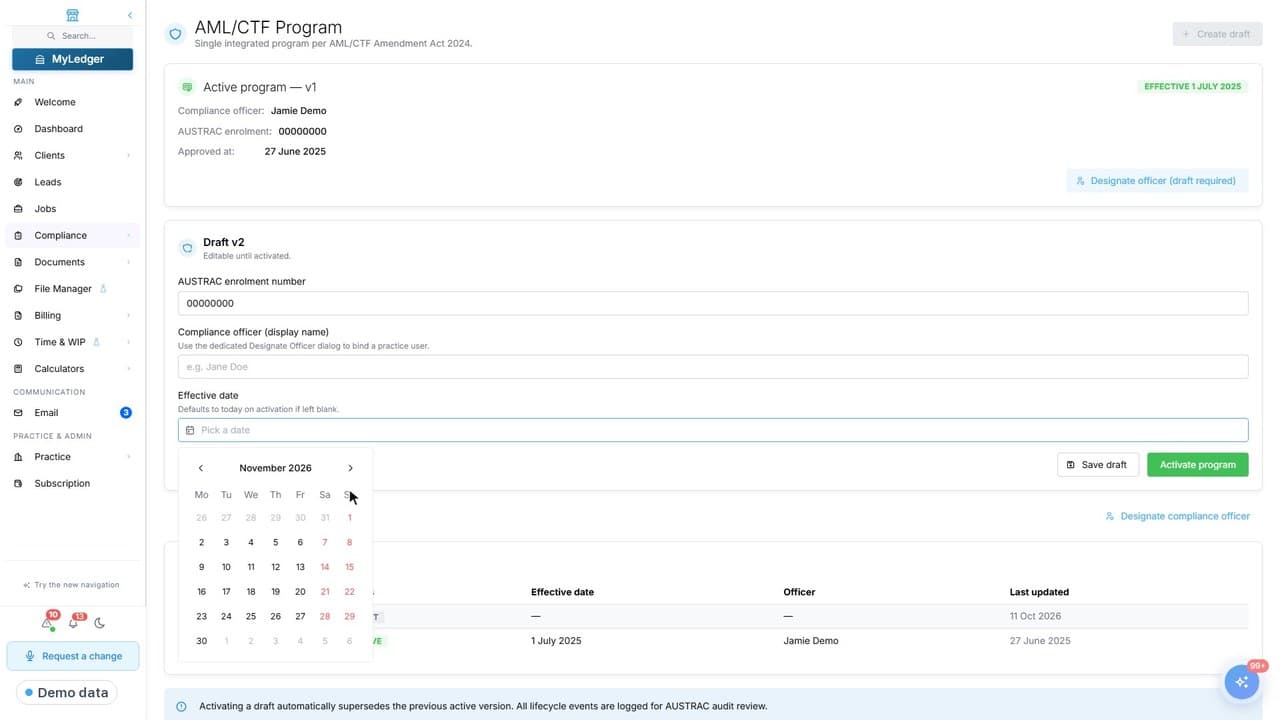 1:27Maintain the practice's AML/CTF programDraft a new program version, designate the compliance officer, activate it once the principal has reviewed it and read the version history.
Recorded on a demo practice with fictional data. English narration with captions.
Included for Fedix customers. $2.90 + GST per verification, no monthly fee.
This is a tool we include for our customers, not a separate AML product. There is no monthly fee; you pay only for the checks you run, and only when a check completes.
What's included at $2.90 + GST
- AI-drafted risk rating (your decision)
- DFAT sanctions screening (DFAT list only)
- AI-assisted political-exposure indicators (not a licensed PEP database)
- Adverse media search
- Document checklist & tracking
- 7-year retention, built to the AML/CTF Act's requirements
What the current regime means for timing
The regime is already in force. Timing turns on whether you provide a covered service, the customer relationship and the applicable CDD or transition rule.
Expanded regime in force
Accounting practices are regulated when they provide covered professional designated services with an Australian geographic link. Being an accountant alone does not make every engagement subject to the regime.
Apply initial CDD where required
For a new customer, work through the initial CDD rules before providing a covered designated service, including any exception or timing rule that applies to the circumstances.
Follow the transition rules
Transition rules are conditional. Risk, suspicious-matter triggers and the services provided can affect when initial CDD is required. Check AUSTRAC's current guidance for each customer cohort.
What the AML/CTF Act asks of a reporting entity
Tranche 2 extends AML/CTF obligations to accountants and other DNFBPs. What your practice must do depends on which designated services you provide. This page is general information, not legal advice.
Failure to have an AML/CTF program
Failure to report suspicious matters
Tipping off about an SMR
Failure to retain records
Civil penalties under the AML/CTF Act are set in penalty units, are indexed, and scale with the size of the entity and the seriousness of the contravention. These are maximums for the largest reporting entities, not a forecast for your practice. This is general information, not legal advice - get your own advice.
Frequently asked questions
Less of the AML/CTF legwork. The obligation stays yours.
Map your own obligations early with AUSTRAC or your adviser, and let Fedix take the paperwork off your desk. $2.90 + GST per verification, no monthly fee.